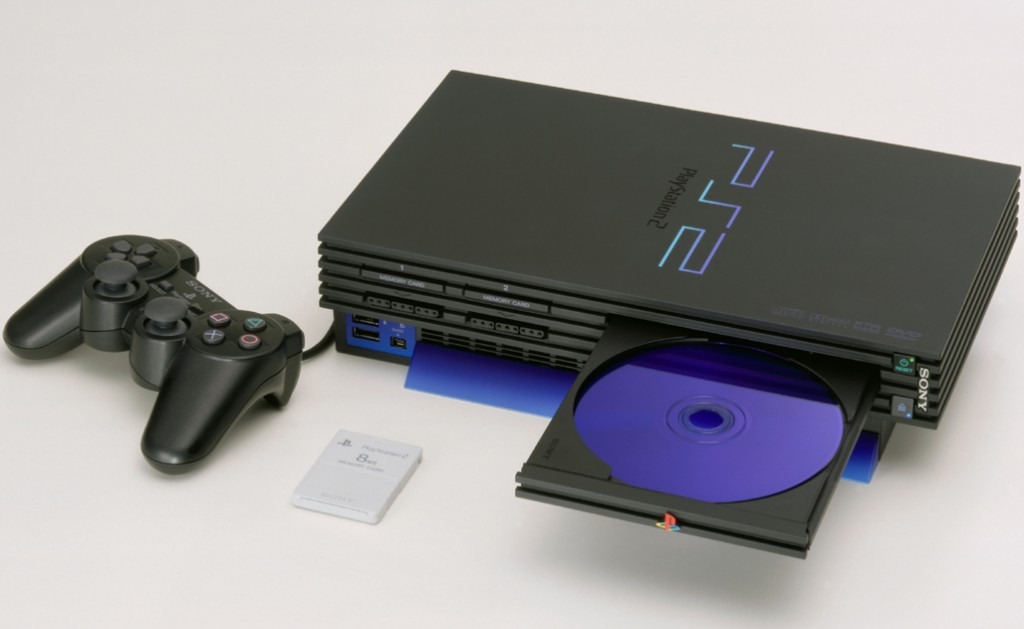
PlayStation 2
Sony's PlayStation 2 is the second home video game console produced by Sony Computer Entertainment Incorporated, and to date is the best-selling home console of all time, with an install base of 150 million units since its launch.
Overview The PlayStation 2
The PlayStation 2 was developed by Sony Interactive Entertainment and was released on March 4th 2000 in Japan, October 26th 2000 in North America, November 24th 2000 in Europe, and November 30th 2000 in Australia. The PlayStation 2 is powered by a 128-bit CPU that Sony co-developed with Toshiba, known as the "Emotion Engine." It was also comprised of a "Graphics Synthesizer" chip (its GPU), a 24x speed CD-ROM (which was also a 4x DVD drive), 2 proprietary controller ports, 2 proprietary memory card slots, a DEV9 expansion bay for a network adapter, and 2 USB 1.1 ports.
The PS2 initially sold well, partly due to the strength of the PlayStation brand and the console's backward compatibility with original PlayStation titles. It sold over 980,000 units by March 5th 2000, or one day after launch in Japan.
Its launch was not without setbacks. Manufacturing delays pushed back the original launch day of the PlayStation 2 to fall in North America. Also, a number of early PlayStation 2 units suffered from disk read errors, which subsequently prompted a class action lawsuit against Sony. Sony agreed to provide free repair services or replacement for the faulty consoles, and continued to do so until February 2005.
At the time, many people in the gaming industry predicted a close match up between the PlayStation 2, Microsoft's Xbox, and Nintendo's GameCube. Several blockbuster games were released for the PlayStation 2 during the 2001 holiday season, which helped maintain sales momentum and hold off its rivals. Sega's Dreamcast was released a full 16 months before the PlayStation 2, but failed to gain momentum. Sega discontinued the Dreamcast in March of 2001, in order to focus on publishing software.
Discontinuation
On December 28th, 2012, Sony confirmed that the PlayStation 2 console had been discontinued in Japan. A week later, Sony confirmed that manufacture of the console had been discontinued worldwide, marking almost 13 years of production for the console. At 150 million units sold worldwide, it is the best-selling console ever.
Launch TitlesJapan - March 4, 2000A-Train 6DrumManiaEternal RingKakinoki Shogi IVKessenMorita ShogiRidge Racer VStepping SelectionStreet Fighter EX3North America - October 26, 2000Armored Core 2Dead or Alive 2: HardcoreDynasty Warriors 2ESPN International Track and FieldESPN X-Games SnowboardingEternal RingEvergraceFantavisionGungriffon BlazeKessenMadden NFL 2001Midnight ClubMoto GPNHL 2001OrphenQ-Ball Billiards MasterReady 2 Rumble Boxing Round 2Ridge Racer VSilent ScopeSmuggler's RunSSXStreet Fighter EX3SummonerSwing Away GolfTekken TAG TournamentTimeSplittersUnreal TournamentWild Wild RacingX-SquadEurope - November 24, 2000Aqua AquaBust A Move 4Donald Duck Quack AttackESPN International Track and FieldESPN X-Games SnowboardingF1 Racing ChampionshipFantavisionFIFA 2001Gradius III & IVInternational Superstar Soccer 2000Madden NFL 2001Midnight ClubOrphenRayman RevolutionRC Revenge ProReady 2 Rumble Boxing Round 2Ridge Racer VSilent ScopeSmuggler's RunSSXSummonerSwing Away GolfTekken TAG TournamentTimeSplittersTheme Park WorldWild Wild RacingX-SquadOnline
Before the launch of Microsoft's online capable Xbox, Sony placed little emphasis on online gaming during the PlayStation 2's early years. In 2002, however, Sony began heavily advertising several online first-party titles, such as SOCOM: US Navy Seals. Although late, and despite the fact that Sony required developers to pick up the responsibility of providing servers, online gaming was one of the major selling points of the PlayStation 2. The original PlayStation 2 consoles did not have an integrated network adapter, requiring instead that the user purchase the unit separately. The launch of the PlayStation 2 Slim model saw the network adapter built into the console.
PlayStation 2 SlimPS2 Slim
In September 2004, in time for the launch of Grand Theft Auto: San Andreas, Sony unveiled one of its major hardware revisions: a smaller, thinner and quieter PlayStation 2 that included a built-in Ethernet port. Called the PS2 Slim, it did not contain a 3.5" expansion bay, thus removing support for an internal hard disk drive. Similar to the GameCube, early models lacked an internal power supply, and had a modified multi-tap expansion. Later models of the PlayStation 2 Slim do not require an external power supply. The removal of the expansion bay was criticized as a limitation due to the existence of titles such as Final Fantasy XI, which required the use of the HDD. The PlayStation 2 Slim model was first released in black, however today the slimline model can be found in silver, white, and pink in North America.
PSX
The Sony PSX (not to be confused with the PlayStation) is a consumer device that can be used as a digital video recorder, DVD burner, and PS2 game player. It also includes built in video, photo, and audio editing software. The device, which has only released in Japan, was poorly received, with some major features absent from the first editions of the hardware. Despite major price drops on the device, sales were very weak in Japan. It is still notable for introduction of the popular XMB interface, now used in Sony's PSP, PlayStation 3, and Bravia TVs.
Accessories and Peripherals
| DualShock 2DualShock 2 The DualShock 2 is the standard controller which comes packaged with the PS2. Visually, it was practically identical to the original DualShock, with the main distinction being its black color. The controller included rumble and had the same button layout as its predecessor, but was lighter, had more accurate analog movement, and featured pressure sensitive buttons. The DualShock 2 is regarded as one of the best controllers ever made, despite some criticisms of parallel analog sticks, shallow buttons, and questionable ergonomics. |
| EyeToyEyeToy Camera One of the most well known of all the PS2's peripherals is the EyeToy. It was a USB vision camera which took images of what the player was doing and relayed it back into games so the player could interact with games using motion. The camera was mainly used with the nine games of the EyeToy franchise but also with other games that used the device's capabilities, such as Dance Dance Revolution EXTREME, although the EyeToy isn't integral to the gameplay experience in most of these games. The camera has serious limitation; it has roughly 1.3 megapixels, and needed a lot of light in the playing area. A red LED turns on when EyeToy doesn't have enough light to distinguish the player from the background. |
| PS2 HDDPS2 HDD Released in North America and Japan, the PlayStation 2 Hard Drive Disk allowed for the storage of up to 40GB. The HDD could be used to reduce load times by caching data on the hard drive. Few North American games had HDD support, and the only game which actually needed the drive was Final Fantasy XI, as it was used to store patches and other game updates. In 2004, the device stopped receiving support from Sony. The Slimline model can't use the HDD without a 3rd party cable. |
Best Selling GamesGrand Theft Auto: San Andreas - 17.33 MillionGran Turismo 3: A-Spec - 14.89 MillionGran Turismo 4 - 10.76 MillionGrand Theft Auto: Vice City - 9.61 MillionGrand Theft Auto III - 7.9 MillionMetal Gear Solid 2: Sons of Liberty - 7 MillionFinal Fantasy X - 6.6 MillionKingdom Hearts - 5.9 Million ShippedFinal Fantasy XII - 5.2 Million ShippedDragon Quest VIII: Journey of the Cursed King - 4.78 Million ShippedHardware SpecificationsGeneral
CPU: 128 Bit "Emotion Engine"
System Clock: 300 MHz
System Memory: 32 MB Direct Rambus
Memory Bus Bandwidth: 3.2 GB per second
Co-Processor: FPU (Floating Point Multiply Accumulator x 1, Floating Point Divider x 1)
Vector Units: VU0 and VU1 (Floating Point Multiply Accumulator x 9, Floating Point Divider x 1)
Floating Point Performance: 6.2 GFLOPS
Compressed Image Decoder: MPEG2Audio
Number of voices: ADPCM: 48 channel on SPU2 plus definable by software
Sampling Frequency: 44.1 KHz or 48 KHz (selectable)I/O
CPU Core: Current PlayStation CPU
Clock Frequency: 33.8 MHz or 37.5 MHz (selectable)
Sub Bus: 32 Bit
Interface Types: IEEE1394, Universal Serial Bus (USB)
Communication: via PC-Card PCMCIA
Disc Media: DVD-ROM (CD-ROM compatible)Graphics
Clock Frequency: 150MHz
DRAM Bus bandwidth: 48 GB Per Second
DRAM Bus width: 2560 bits
Pixel Configuration: RGB:Alpha:Z Buffer (24:8:32)
Maximum Polygon Rate: 75 Million Polygons Per Second (Theoretical Peak)
3D CG Geometric Transformation: 66 million Polygons Per Second (Theoretical Peak)
Manufacturer
Sony Interactive Entertainment
Sony Interactive Entertainment is a subsidiary of the Sony Corporation responsible for Research & Development, production, and sales of hardware and software for the PlayStation line of handheld and video game consoles.