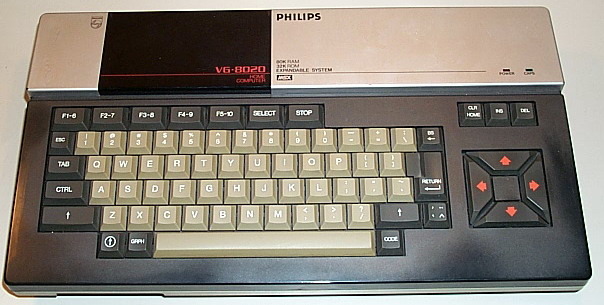
MSX
MSX is a standardized home computer architecture. It was popular in Japan, South Korea, Brazil, Netherlands, France, Spain, Finland, Arabian Gulf countries and former Soviet Union during the 1980s. Like the PC of today, the MSX computers were manufactured by many different companies.
History
The MSX home computer architecture standard was conceived by ASCII Microsoft executive Kazuhiko Nishi. Inspired by the success of VHS as a standard for video cassette recorders he had proposed the MSX standard as a single industry standard for home computers. This was many years before the PC later became a standardized home computer architecture.
The MSX standard was first formally announced in 1983 and was followed by three other standards: MSX2 (1986), MSX2 (1988) and MSX turbo R (1990).
Over a hundred different companies have manufactured MSX computers. The list of companies includes: Sony, Panasonic, Sanyo, JVC, Spectravideo, Toshiba, Canon, Casio, Dragon, Dyndata, Fujitsu, Hitachi, Sharp/Epcom, Pioneer, Alalamia, Mitsubishi, NEC, Philips, Radiola, Schneider, Talent, Telematica, Yamaha, Yashica, Aster International, General, Samsung, Hyosung, Limco, Oric, Radofin.
Although it was developed by Microsoft's Japanese partner, Microsoft itself showed little support for the project beyond making the system software, and the MSX-based machines were seldom seen in the United States. Most of the Japanese companies decided to avoid the intensely competitive U.S. market, only Spectravideo and Yamaha decided otherwise. The MSX computers became popular in Japan, South Korea, Brazil, Netherlands, France, Spain, Finland, Kuwait and former Soviet Union. A total of 5 million MSX-based units were sold world-wide.
Standard definitionMSX
Processor: Zilog Z80A 3,579 MHz (8-bit)ROM: 32 KBRAM: 8 KB minimum (Most machines provided 64K.)Video Display Processor: Texas Instruments TMS-9918/TMS-9928/TMS-9929Video RAM: 16 KB (Maximum resolution: 256×192 pixels with 16 colors)Sound chip: General Instrument AY-3-8910 (PSG)Connector for tape/data recorder.A Centronics interface (interface for connecting printers and other parallel devices)At least one joystick/mouse/paddle/trackball/graphic tablet connector. (Most computers have two.)At least one expansion port.A keyboard with At least 70 keys (including five function keys with ten programmable functions and four arrow keys).
MSX2 (only changed to MSX listed)
ROM: 48 KBRAM: 64 KB minimumVideo Display Processor: Yamaha V9938Video RAM: At least 64kB (usually 128kB)Sound chip: Yamaha YM2149 (PSG)Clock chip: Ricoh RP5C01 (or compatible)A 3.5" Floppy disk drive was common
MSX2+ (Only released in Japan)
Processor: Zilog Z80 compatible running at 3.58 MHz or more (5.37 MHz versions were available)ROM: 64 KBRAM: At least 64 KBVideo Display Processor: Yamaha V9958Sound chip: Yamaha YM2149 (PSG)Optional sound chip: Yamaha YM2413 (OPLL) (MSX-Music)Clock chip: RP5C013.5" Floppy disk drive was very common
MSX turbo R (Only two machines were made and they were only released in Japan)
Processor: R800 (7.16 MHz) and Zilog Z80A compatibleROM: 96 KBRAM: 256 KB (FS-A1ST) or 512 KB (FS-A1GT)Video Display Processor: Yamaha V9958Sound chip: Yamaha YM2413 (OPLL) (MSX-Music)Sound chip: PCM synthesizer 8-bit (sample rate 16kHz)Sound chip: MIDI in/out (FS-A1GT only)3.5" double sided double density (720kB) disk drive
Manufacturer
ASCII Corporation
Japanese publishing company that was founded in 1987, and produced games exclusively on the Japanese market.