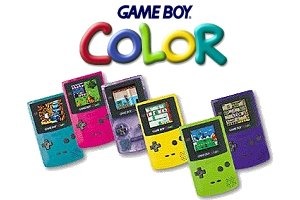
Game Boy Color
Nintendo's successor to the Game Boy, featuring a color screen and backwards compatibility for all previous Game Boy titles.
Overview A Yellow Game Boy Color
The Game Boy Color was Nintendo's second handheld video game console, and the successor to the Game Boy. It was released on November 19, 1998 in North America, on October 21, 1998 in Japan, on November 23, 1998 in Europe, and in 1999 in Australia. Unlike its predecessor, it featured a color screen. It was smaller than the original Game Boy, but slightly larger than the Game Boy Pocket. The Game Boy Color only used 2 AA batteries as compared to the originals 4, and the Game Boy Pocket's 2 AAA's. Combined sales of the Game Boy and Game Boy Color were charted at 118.69 million worldwide. Total Sales for Japan reached 32.47 million units, 44.06 million in the the Americas, and 2.16 million in other regions.
The Game Boy Color was originally a response by Nintendo from the pressure of developers for new and more sophisticated hardware. Developers felt that the Game Boy, and even the recently released Game Boy Pocket, were far too simple and stifled creative ability. To combat this, Nintendo released the Game Boy Color. The Game Boy Color was the first handheld video game console to be backwards compatible, meaning that original Game Boy games could be played on it. This has since become a standard in the Game Boy line. The Color boasted a processor twice as powerful as its predecessor, as well as four times the available system memory. This allowed for developers to create much larger and longer games than possible with the original systems specifications.
Cartridge Types
Many games released during the Game Boy Color's run were developed to be still be compatible with the older Game Boy classic and Game Boy Pocket. Cartridges that were backwards-compatible with the older hardware kept the traditional Game Boy cartridge shape, but were colored black instead of the traditional gray. Games exclusive to the Color, however, were released in a clear cartridge with a bulging extraction grip, as opposed to the traditional indented one.
Launch TitlesJapanDragon Warrior MonstersHexcitePocket BowlingTetris DXWario Land IINorth AmericaCentipedeGame & Watch Gallery 2Pocket BombermanTetris DXEuropeTetris DXGame and Watch Gallery 2CentipedePocket BombermanHardware SpecificationsProcessor - Similar to the Z80, manufactured by Sharp with some bit manipulationClock Speed - 8 MHzMemory - 32 kilobytes of system RAM, 16 kilobytes of video RAMScreen Resolution - 160x144 pixelsColors - 56 simultaneously onscreen from a palette of 32,768 colorsColors
Several different colors of the system was produced, many being limited or special editions.
Pokémon editionBerryGrapeKiwiDandelionTealAtomic PurplePokémon Gold/Silver editionPokémon editionPokémon Center editionHello Kitty edition (Japan only)Clear (Japan only)Clear blackClear green (Japan only)Midnight blueIce blueClear orange (Japan only)Clear blueTommy Hilfiger EditionGames
The Game Boy Color featured an extremely robust library. Over the life of the system, Pokemon Gold/Silver and The Legend of Zelda: Oracle of Seasons / Oracle Of Ages emerged as the best-sellers, selling 14.51 million and 7.92 million copies, respectively.
Manufacturer
Nintendo
Nintendo was founded in Kyoto, Japan in 1889 as a manufacturer of hanafuda playing cards. The company went through several small niche businesses before becoming a video game company.