Game Boy Advance
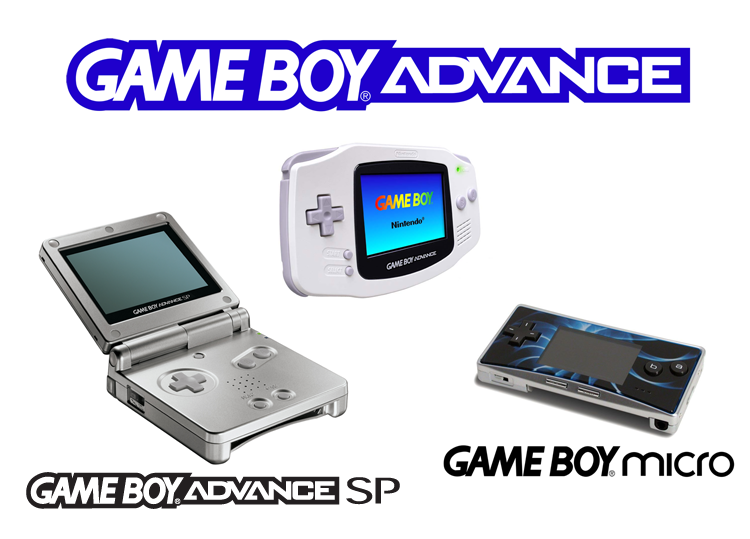
The third platform in the Game Boy line, the Game Boy Advance was offered in a multitude of colors and had three hardware offerings, the sideways Game Boy Advance, the flip Game Boy Advance SP and the tiny Game Boy Advance Micro.
Overview Game Boy Advance Logo
The Game Boy Advance (originally codenamed "Atlantis") was originally launched in Japan on March 21, 2001 and then in North America on June 11. It is the third platform in the Game Boy hand-held line and like it's predecessors, the Game Boy Advance established itself as the leader in the portable market. The Game Boy Advance continued the Game Boy Color trend of offering different colors and special branded limited editions. It also established the trend of a periodic hardware redesign (see below), which was carried on with the Nintendo DS and DS Lite. The Game Boy Advance series has had sales of over 81 million worldwide, approximately 43 million of which are Game Boy Advance SP units.
Launch TitlesJapanAdvance GTAAkumajo Dracula: Circle of the MoonBakunetsu Dodgeball FightersBoku wa Koukuu Kansei-AnChuChu Rocket!EZ-Talk Shokyuuhen 1-6 Kan SetFire Pro Wrestling AJ-League PocketJTO Golf Master: Japan Tour Golf GameKuru Kuru KururinKonami Wai Wai Racing AdvanceMomotaro MatsuriMonster GuardiansMr. Driller 2NapoleonPinobee no DaiboukenPower Pro-Kun Pocket 3Rockman.EXESilent Hill: Play NovelSuper Mario AdvanceTweety no Hearty PartyWinning Post for Game Boy AdvanceYu-Gi-Oh! Dungeon Dice MonstersZen Nihon GT SenshukenNorth AmericaArmy Men AdvanceCastlevania: Circle of the MoonChuChu Rocket!Earthworm JimF-Zero: Maximum VelocityFire Pro WrestlingGT Advance Championship RacingIridion 3DKonami Krazy RacersNamco MuseumPinobee: Wings of AdventurePitfall: The Mayan AdventureRayman AdvanceReady 2 Rumble Boxing: Round 2Super Dodge Ball AdvanceSuper Mario AdvanceTony Hawk's Pro Skater 2EuropeF-Zero: Maximum VelocityTop Gear GT ChampionshipKonami Krazy RacersKuru Kuru KururinReady 2 Rumble Boxing Round 2Super Mario AdvanceTony Hawk's Pro Skater 2Tweety and The Magic JewelCastlevania: Circle of the MoonGamesA typical Game Boy Advance cartridge.
The Game Boy Advance's hardware was very similar to the SNES's, which made it perfect for sprite-based games. It had many ports of SNES titles, including a large number of RPGs. As well as being known for its SNES remakes and great original content a lot of original NES games were made available to play on the move thanks to the NES Classic's Series. The Game Boy Advance is regarded as an incredibly popular console among old school gamers and many call it Nintendo's best handheld in terms of games. The last game to be release for the Game Boy Advance was Samurai Deeper Kyo which was released on February 12, 2008 in North America. As of March, 2009 there has been over 377 million GBA games sold worldwide.
Best Selling Games Worldwide
Pokémon Ruby/
Sapphire (13 million)
Pokémon FireRed/
LeafGreen (11.82 million)
Pokémon Emerald (6.32 million)
Super Mario World: Super Mario Advance 2 (4.179 million approx)
Super Mario Advance (3.938 million approx)
Mario Kart: Super Circuit (3.768 million approx)
Super Mario Advance 4: Super Mario Bros. 3 (3.698 million approx)
Namco Museum (2.96 million in US)
Pokémon Pinball: Ruby & Sapphire (2.5 million)
Pokémon Mystery Dungeon: Red Rescue Team (2.2 million)Hardware Revisions
There were three different models offered during the lifespan of the Game Boy Advance.
| Game Boy Advance (GBA) |
|---|
| The original Game Boy Advance was released with a horizontal design. This model is backwards compatible with games for the Game Boy and Game Boy Color. Many gamers complained that the screen was not bright enough on this model and many third party lighting accessories were developed, this issue was fixed in the next iteration. | Indigo |
| Hardware SpecsCPU: 32-bit RISC CPU with embedded memoryScreen: 2.9" Reflective TFT Color LCDDisplay Size: 1.6" by 2.4" (40.8 by 61.2 mm)Resolution: 240 x 160 pixelsColors: 512 simultaneous colors from a palette of 32,768Size: 3.2 by 5.6 by 1 inch (82 by 144.5 by 24.5 mm)Weight: Approximately 5 ounces (140 grams)Power Supply: 2 AA alkaline batteriesBattery Life: Approximately 15 hours continuous play | Launch Date: June 11, 2001Launch Price: 9.99 |
| Game Boy Advance SP |
|---|
| The Game Boy Advance SP not only saw a major change with its flip design, but also added a built-in (but removeable, with tools) rechargeable battery and front mounted light. Like the original GBA, the SP is backwards compatible with all Game Boy and Game Boy Color games. This version did not have a standard headphone jack, and users dissatisfied by the small built-in speaker needed either proprietary Nintendo headphones or an adapter. In September of 2005, a back-lit model of the SP was released. This version of the hardware is recognizable by the model number AGS-101. | Famicom version |
| Hardware SpecsCPU: 32-bit RISC-CPU with embedded memoryScreen: 2.9" Reflective TFT Color LCD Display Size: 1.61" x 2.41"Resolution: 240 x 160 pixels Color:Simultaneously display more than 32,000 colorsSize (Closed): Height 3.33 inches, width 3.23 inches, depth 0.96 inchesWeight: Approximately 5 ounces (140 grams)Power Supply: Lithium-Ion rechargeable batteryBattery Life: Approximately 10 hours of continuous play with light, 18 hours without light | Launch Date: March 23, 2003Launch Price: $ 99.99 |
| Game Boy Micro |
|---|
| Tiny in size, the third design (originally codenamed "Oxygen") borrowed from the then-popular cell phone trend of having interchangeable face-plates. Featuring a brighter screen than the SP (with 5 levels of adjustable brightness) and a standard headphone jack (found at the bottom of the unit), but with an external port unique to the Micro which did not accept a standard GBA link cable (though a cable exclusive to the micro was released) and able to play Game Boy Advance games only, this version of the platform never achieved the success of the previous two versions. | |
| Hardware SpecsCPU: 32-bit RISC-CPU (16.78 MHz)Screen: 2-inch diagonal screen TFTDisplay Size: 1.61" x 2.41"Resolution: 240 x 160 pixelsColor: 512 out of a maximum 32,000 colorsSize: Measures 4 by 0.7 by 2 inchesWeight: Approximately 2.8 ouncesPower Supply: Lithium-Ion rechargeable batteryBattery Life: Approximately 6 to 10 hours, depending on brightness level. | Launch Date: Sept 19, 2005Launch Price: .99 |
Official Nintendo Accessories
Many accessories were created for the Game Boy Advance line.
| Game Link Cable | |
|---|
| This 4-port cable allowed between 2 and 4 Game Boy Advance units to communicate for multiplayer games or to share or trade data. The game that is best known for its use of this accessory is The Legend of Zelda: A Link to the Past & Four Swords, which is the GBA remake of the SNES classic. | |
| Nintendo Gamecube Game Boy Advance Link Cable | |
|---|
| This cable allowed you to use your GBA with certain Gamecube games, such as The Legend of Zelda: Four Swords Adventures, Pac-Man VS and Final Fantasy: Crystal Chronicles, as a controller (with screen!) for your Gamecube. Some other games also used the accessory for side featrures, for example being able to travel to | |
| Game Boy Wireless Adapter | |
|---|
| The wireless adapter was a great alternative to the wired Game Link cable, but only worked with certain games designed specifically for it. As it was released relatively late in the handhelds life less than 20 games supported it the most pominent tat offered support was Pokemon FireRed/LeafGreen which had the adapter included with the game. | |
| e-Reader | |
|---|
| This optical scanner was released in 2001 and co-created with Olympus Optical, Ltd. It worked with specially printed dot-patterned cards which could be used to unlock bonus content in games, most notably Super Mario Bros. 3: Super Mario Advance 4 (which had the most ambitious e-Reader release of all, with multiple packs of cards adding items, levels, and even "professional" replays), or to play entire games, especially retro titles like the Game and Watch series, or Nintendo Arcade Classics, like the original Donkey Kong. The device was inserted into the cartridge slot of the Game Boy Advance, (shown here to the right), and featured a pass-through port to allow connection of multiple Game Boy Advance units using the standard Game Link Cable. The e-Reader served as a bootable cartridge, and had onboard memory to store one game at a time, but for most other features more than one GBA was required, since there was no other way for data to be transferred to a game cartridge, severely limiting its usefulness. | |
| Game Boy Advance SP Headphone Jack Adapter | |
|---|
| This short cable connected to the charging port of the SP and allowed the user to connect a standard 3.5mm headphone jack instead of the charger. Many third parties improved on this design by allowing both the headphone jack and the charger to be used simultaneously. | |
| Game Boy Player | |
|---|
| This device allowed you to play GBA games on your television by connecting it to your GameCube. The device installed semi-permanently to the bottom of the Gamecube and booted with a standard Gamecube disc. The Game Boy Advance cartridges were inserted in the front of the device, visible in the center of the bottom left-hand side of the picture (right). | |
Manufacturer
Nintendo
Nintendo was founded in Kyoto, Japan in 1889 as a manufacturer of hanafuda playing cards. The company went through several small niche businesses before becoming a video game company.