FM-7
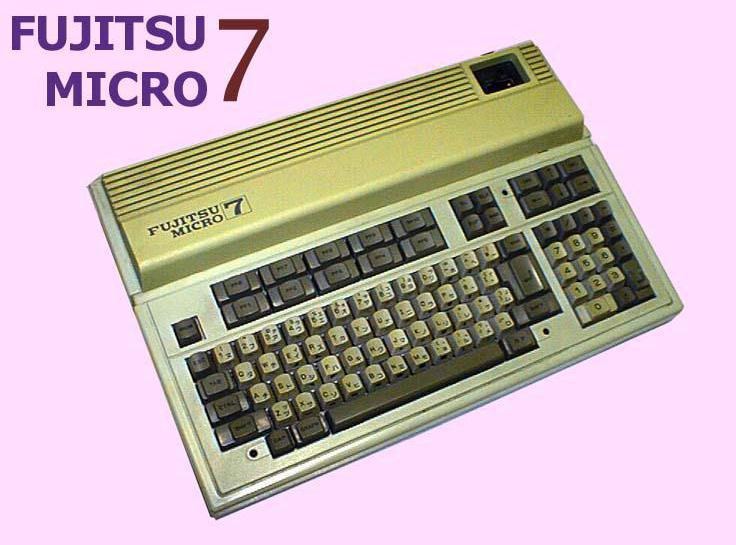
The second in Fujitsu's FM line of computers, the FM-7 was intended more for the mass market, and received fair popularity in Japan.
Overview The demo screen for the FM-7
The FM-7, an acronym for "Fujitsu Micro 7," was the second home computer released by the Japanese computing company Fujitsu. It was released in Japan in November 1982, for ¥126,000 (0 in 1982 dollars, or 00 in 2013 dollars). Alongside the Sharp X1 and NEC PC-8801, it was considered to be one of the big three Japanese personal computers of the early 1980s.
The most notable model for computer gaming was the FM-77 AV, which in 1985 introduced a simultaneous display of 4096 colors, surpassing the 8 color display of other 8-bit home computers at the time.
The FM-7 was released almost simultanously with the FM-11 EX (intended for businesses), and was preceded by the FM-8 (Fujitsu's first home computer release). Fujitsu were also later responsible for the FM Towns, the powerful 32-bit successor to the FM-7.
The FM-7 was similar to Radio Shack's TRS-80 Color Computer (colloquially referred to as the "CoCo") in some ways, especially CPU processor (both used the 8-bit Motorola 6809) and included features. One such feature is F-BASIC, very similar to the CoCo's "Microsoft CoCo BASIC." F-BASIC is essentially a simplistic programming language, including a katakana and kanji character set, graphics manipulation, and music.
Model Variants
There were several different versions of the FM-7 released following the initial release in 1982, including the FM-New 7 and FM-77.
A major breakthrough for computer gaming came in 1985, with the release of the FM-77 AV, the first computer model to break the 8-color barrier of 8-bit computers and achieve a simultaneous display of 4096 colors. In addition, the FM-77 AV also came with a built-in Yamaha FM synthesis sound board, providing higher-quality audio.
FM-7 models included:
FM-77 AV FM-New 7 (1984)FM-77 (1984)FM-77 L2 (1985)FM-77 L4 (1985)FM-77 AV (1985)FM-77 AV20 (1986)FM-77 AV40 (1986)FM-77 AV20 EX (1987)FM-77 AV40 EX (1987)FM-77 AV40 SX (1988)Technical SpecificationsProcessors
Main CPU (Central Processing Unit) processor: 1982: Fujitsu MBL 68B09 (based on 8-bit Motorola 68B09) @ 4.9 - 8 MHz1984: Fujitsu MBL 68B09 (based on 8-bit Motorola 68B09) @ 8 MHz1985: Fujitsu MBL 68B09E (8-bit) @ 2 MHz (equivalent to MBL 68B09 @ 8 MHz)GPU (Graphics Processing Unit) processor: 1982: Fujitsu MBL 68B09 (based on 8-bit Motorola 68B09) @ 2 MHz1984: Fujitsu MBL 68B09E (8-bit) @ 2 MHz1985: Fujitsu MMR (Memory Mapping Register), Fujitsu MBL 68B09E (8-bit) @ 2 MHzOptional CPU processor: Zilog Z80 (8-bit)MemoryMain RAM (Random Access Memory)1982: 64 KB1984: 64-256 KB1985: 128-256 KB1986: 128 KB / 192 KB / 448 KBVideo RAM (VRAM) memory: 1982: 48 KB1985: 96 KB1986: 96-144 KB1987: 96-192 KB1988: 192 KB
ROM (Read-Only Memory) memory: 48 KB (1982), 72 KB (1985)Storage: Default: 10-20 MB hard disk drive (1982), 1x-2x 3.5" DD floppy disk drives (1984)Optional: Cassette tape, 5.25" floppy disk3.5" DD (double-density) floppy disks: 320 KB each (1984), 640 KB each (1986)Display
Maximum display resolution: 640x200 pixels (1982), 640x400 pixels (1984)
Maximum color palette: 8 (1982), 16 (1984), 4096 (1985), 262,144 (1986)
Simultaneous display colors: 1982: 3 colors (monochrome), 8 colors (4-bit color)1984: 8 colors at 640x200, 2 colors at 640x4001985: 4096 colors at 320x200, 16 colors at 640x200, 2 colors at 640x4001986: 4096 colors at 320x200, 16 colors at 640x200, 8 colors at 640x4001987: 4096 colors at 320x200, 32 colors at 640x200, 16 colors at 640x400Monitors: Multi-monitor support for 2-6 monitors (1985)Video digitization: Supported (1985), Standard (1988)Sound1982: General Instruments AY-3-8910 sound chip (PSG synthesizer, 3 channels, 8 octaves)1985: Yamaha sound board (FM synthesis, 3 channels), AY-3-8910 sound chipInterface
Interface: Tape, RGB, RS232, Joystick (2), ROM/RAM cartridges, BUSExternal linkIPSJ Computer Museum article on FM-77 AV
Photo Gallery
 All Images
 All Images
Manufacturer
Fujitsu
Japanese company that makes electronics and stuff. In the home computer market, Fujitsu is best known for manufacturing the FM-7 and FM Towns computers. In the arcade market, Fujitsu manufactured GPU graphics chips for various arcade game systems from Taito, Midway and Sega.